


 Radishes
  Leeks
Leeks  Vegetable garden: growing tomato







Eating isn’t just about counting calories or ticking off nutrients. It’s also about the choices we make, some of which are conscious, while others are cultural or ethical. And yet, each diet—vegetarian, Western, vegan or flexitarian—influences our health differently by modifying our intake of proteins, fiber, vitamins or minerals. So what are the benefits, risks, and limitations? Here, we provide a quick overview to help you make sense of the situation.
Before going into the specifics of each type of diet, let’s remember the basics: our body needs a certain quantity of different nutrients to ensure all its vital functions. Proteins, carbohydrates, fat (or lipids), vitamins, minerals, fiber, etc. all have a role to play1.
The basics: what does our body really need?
Proteins provide the building blocks (amino acids) needed to develop and maintain muscles, organs, enzymes, hormones, etc.; carbohydrates are the body’s main fuel; lipids serve as energy reserves in fatty tissue and contribute to cell structure; and the major vitamin and mineral families play a vital role in many biological functions. They regulate the immune system, contribute to growth and the nervous system, have antioxidant functions and foster strong bones and teeth. Fiber, meanwhile, is crucial for digestion, satiety, and the health of our intestinal microbiota.
Intake varies with foods… and thus diets
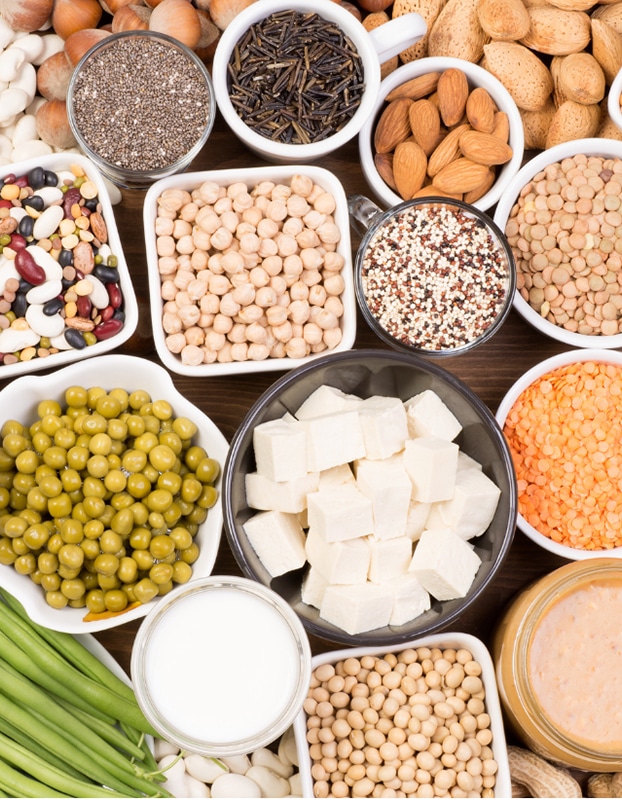
The nutrient compositions of different types of food vary widely: meat is rich in protein, iron, and vitamin B12; fruit and vegetables contain fiber and numerous vitamins, mainly B9, beta-carotene, and C, etc. A plant-rich diet will therefore not have the same nutritional profile as a meat-rich one.
Western: anything goes… but at what cost to our health?
The Western diet, or ‘omnivore’ as it is known in Europe, has no restrictions, so you can eat anything. Compared to nutritional recommendations2,3,4, we consume too many animal products and ultra-processed foods, leading to excess protein, saturated fat, and salt, and not enough fruit and vegetables, whole grains, and oily fish, resulting in an intake that is too low in fiber, iron, folate, iodine, calcium, and omega-3s, for example. This type of diet is associated with a higher risk of being overweight and developing diabetes, cardiovascular disease, and certain cancers.
Vegan: high in fiber and antioxidants, but prone to deficiencies
Conversely, the vegan diet (which excludes all animal products, including eggs, milk, honey, etc.) offers high intakes of fiber, antioxidants, and unsaturated fats, with benefits for cardiovascular health and diabetes, but presents risks of deficiencies (vitamin B12, iron, etc.) if poorly planned2,3. As a result, it is not recommended for infants, children, teenagers,4, or women who are pregnant or breastfeeding.
Vegetarian: midway between balance and diligence
The vegetarian diet (which draws its protein sources from plants such as pulses and cereals, and excludes ‘only’ meat and fish) reduces the risks of deficiency, while retaining the same health benefits (as it is also rich in fiber, antioxidants, and unsaturated fatty acids). 2,3 Pescatarianism, which allows fish, further reduces the risk of deficiencies.
Flexitarian: a multi-faceted concept
The flexitarian diet—which is rich in plant-based products, with limited meat consumption and no exclusion of any food category— offers benefits close to those of vegetarianism, while covering all our nutritional needs2,3. In practical terms, ‘flexitarian eating’ encompasses a wide variety of dietary practices: Mediterranean diet, Western diet with regular vegetarian meals, vegetarian diet with occasional meat-based meals, etc. Thanks to its flexibility, it is now widely used to support the transition to a more sustainable diet.
Beyond nutrients: pleasure, culture, and convictions
Bear in mind that nutrition studies are based on ‘average’ intakes and requirements, calculated for the overall population. The problem is that nutrient requirements vary significantly from one individual to the next , depending on their metabolism, age, level ofphysical activity, general healthetc. Andfood is not just about nutrients: it also has aspects related to pleasure, culture, the planet and ethical convictions.
((conclusion)) Whether you eat everything, are cutting back on meat or going vegan, the important thing is to be aware of your body’s needs and to adjust your intake accordingly. Read up about what’s important, experiment, and see a professional nutritionist if you suspect an imbalance. The best diet is one that nourishes your body and convictions, while ensuring that eating remains an enjoyable experience.
References
1Alimentation : quels besoins et apports nutritionnels ? (Diet: what needs and nutritional intakes?), Anses
2 Moreno, L., et al. Perspective: Striking a balance between planetary and human health—Is there a path forward? Advances in Nutrition, 2022.
3 Viroli, G., et al. Exploring benefits and barriers of plant-based diets: Health, environmental impact, food accessibility and acceptability. Nutrients 2023, 15, 4723.
4 Recommendations from the Groupe francophone d’hépatologie, gastroentérologie et nutrition pédiatriques (GFHGNP), 2020.
((inset)) Who eats what in Europe?
Omnivores: 62%
Flexitarians: 27%
Meat-free diets: 12% (pescatarians 4%; vegetarians 5%; vegans 3%)
Source: https://gfieurope.org/industry/european-consumer-insights-on-the-alternative-protein-sector/